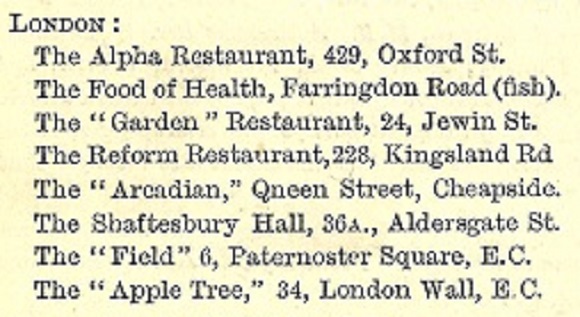
In 1881 the entire UK had just 20 lacto-ovo vegetarian eating places & 22 food stores.
The first title is ‘tongue in cheek’,HappyCow started in 1999, this ‘Directory’ is 118 years older, it is from the December 1881 issue of The Dietetic Reformer & Vegetarian Messenger – more discussion below.
Alpha (Greek: Άλφα) is the first letter of the Greek alphabet. The ‘Alpha’ Restaurant is usually regarded as being the first vegetarian restaurant in London. It was opened in 1879 by a highly ‘controversial’ couple –
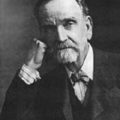
Thomas Low Nichols(1815–1901) – dietitian, author, reformer; born in Orford, N.H. As a journalist and prolific author he promoted health foods, free love, and spiritualism, among other reforms. After earning a medical qualification (1850) he joined his wife, physician Mary Grove Nichols, in training hydropathic physicians. They lived in England and Europe after 1861.
Mary Gove Nichols (1810 – 1884) – became an early advocate of women’s healthcare, spreading her message through her writings, lectures, and clinics. She was influenced by Sylvester Graham, hydrotherapy and vegetarianism. She was also part of the Free Love movement.
“In my early days a vegetarian was looked upon as a poor misguided crank who was expected to apologise for his ‘queer’ ways. Now, it is the meat-eater who apologises for his ways. In London there were no vegetarian dining places until Dr. Nichols, in 1879, opened the ‘Alpha’ Restaurant, in Oxford Street. Now, there are many, and most of the others have a vegetarian section.” – the interview in full – here.
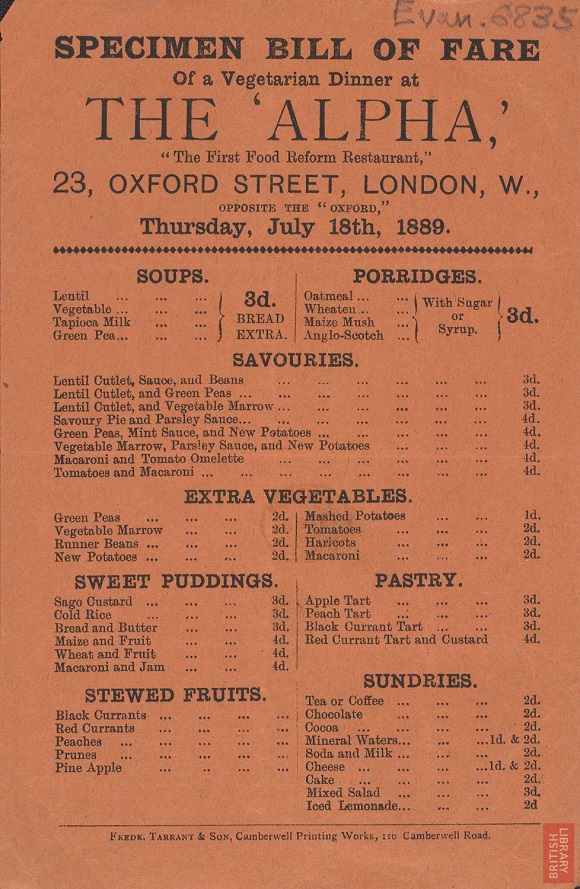
An 1889 ‘Alpha’ menu in the British Library – reproduced with permision – (C) British Library BoardEvan.6835
In our Ernest Bell Library, we have an original magazine ‘review’ of a dinner enjoyed at the ‘Alpha’ in 1880. It was written by a scholar. Transcribed, after decoding the Latin references, – here.
We have special affection for Thomas Low Nichols. He convinced our Ernest Bell to give up flesh eating –
Ernest Bell’s – ~ ….work for animals began in 1873, when he joined the R.S.P.C.A. About the same time he read a review in the Spectator of a pamphlet by Dr. T. L. Nichols, one of our Vice-Presidents, on “How to live on Sixpence a Day,” and this was his first introduction to vegetarianism. Following this up he came to realize, what many lovers of animals do not, that flesh-eating is at once unnecessary and cruel, and that the believer in humanity to animals should be a vegetarian. Therefore, in 1874, he became a vegetarian. Not content with having found the truth he wished to help others to find it, and so he joined The Vegetarian Society. ~ – transcribed in full – here.
~ It is interesting to note too, that it was through food-reform that he was led into animal-reform. The introduction took place in 1874, whilst he was a student at Cambridge, through reading a pamphlet by Dr. T. L. Nichols, entitled “How to Live on Sixpence a-Day.” He was much benefited by the humane diet, and his growth to a fuller recognition of the kinship of all life was swift and basic. ~ – transcribed in full – here.
We have both the original Spectator article (but it is dated 1876 – so perhaps Ernest Bell had got the sequence of events slightly wrong after 50 years) & the booklet “How to Live on Sixpence-a-Day”.
Favorite lines from – “How to Live on Sixpence-a-Day”. by Dr. Thomas Low Nichols – first written in London in 1871.
~ Fruit is the most natural, healthful, and delicious part of our diet. Man’s true place and proper food is in a garden. No food is so cheap if our soil were but given to it; in no way would an acre of ground give us so much or cost us so little. In the tropics such trees as the date and banana furnish great quantities of food on a moderate surface. One thousand square feet of land, 50 feet by 20 feet, or the size of a small back yard to a London house, will produce 38 lbs. of wheat, 462 lbs. of potatoes, or 4000 lbs. of bananas a-year. It would therefore feed a man with wheat, say 38 days, with potatoes, 30 days, with bananas four or five years. A little garden in the tropics will keep a large family. Even a single date tree is quite, sufficient, and millions of people live on dates, the bread of the desert, nine months in the year. ~ – more.
Dr. Nichols writing in 1885 – he regularly proposed eating only fruits / vegetables & bread – ……but he included eggs & milk products in his restaurant’s menu & …… he consumed ‘a little milk’ himself.
~ I have abundantly shown in “How to Live on Sixpence a-Day,” in “The Diet Cure,” in ” Esoteric Anthropology,” in “Human Physiology,” in numberless articles in the Herald of Health, that man was originally, and is naturally, a fruit-eating animal, like the animals which, in his anatomy and physiology, he most nearly resembles, and from which some naturalists believe he has descended or ascended. “Our nearest relations” are arborial and frugivorous. They live in trees, and feed on fruits. Fruits, plants, and seeds were the food of Eden and the “Golden Age.” Bread is the staff of life, and four-fifths of the human race have ever lived, and still live upon fruits, seeds, and vegetable substances — upon bananas, dates, figs, grapes, oranges, apples, melons, rice, maize, wheat, barley, oats, yams, potatoes, beets, turnips, onions, cabbages, etc., etc. — the wondrously varied, delicious, sufficient, and most pure and healthful products of the vegetable kingdom. ~— “Health” a Lecture by Dr. Nichols – more here.
We are looking after a long run of vegetarian magazines from this period. They discuss the formation & opening The ‘Alpha’ & of several other restaurants around the UK . Some restaurants were started by ‘Subscription’ – an early version of crowd-funding. They also contain details ofFrancis W. Newman’swork / efforts. They detail Newman’s attempt to introduce veganism in the UK in late 1871 – detailedhere.
‘The Dietetic Reformer & Vegetarian Messenger’ – January 1872 to December 1885 – 168 monthly issues – 14 complete years
There are currently more than 3,000 items in the Ernest Bell Library.
We will complete the cataloging of the collection as & when adequate funds are available.
It is long past time for the library to go online!
“I have little doubt that the proposal for the establishment of an Ernest Bell Library, which would specialize in humanitarian and progressive literature, and so form a sort of centre for students, will meet with a wide response.”