
Popeye The Sailor — Be Kind to “Aminals” # 19 February 22, 1935
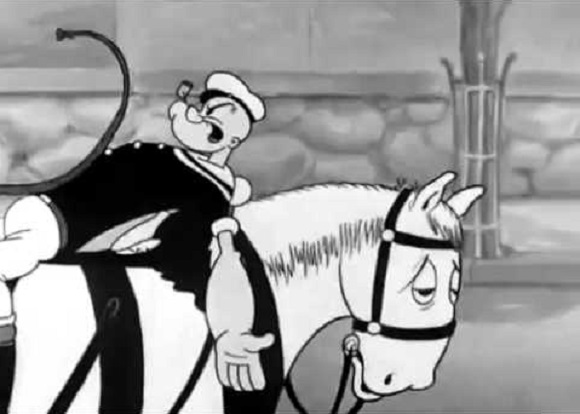
Popeye and Olive can’t ignore it when Bluto is passing by with his terribly overloaded cart.
Bluto is whipping his horse and denying it water.
Bluto fights them off for a while, but Popeye and Olive ultimately prevail.
Eat More Veggies
Popeye later attributed his strength to spinach. The popularity of Popeye helped boost spinach sales. Using Popeye as a role model for healthier eating may work; a 2010 study revealed that children increased their vegetable consumption after watching Popeye cartoons.
……researchers at Mahidol University in Bangkok have discovered a better method than coercion. Their study, published in the current issue of the journal Nutrition & Dietetics, found that kindergarteners pick up better eating habits while socializing and learning about health benefits with peers.
Researchers had the children do a number of activities, such as take cooking classes and watch cartoons. One of the methods used to introduce new foods to fussy kids was a classroom tasting party. Various fruits and veggies were set up to taste, while children reviewed the names and usefulness, played games and sang songs. It was also important for the children to be involved in the food preparation.
……the tasting party study also found that children increased their vegetable consumption after watching Popeye cartoons. ~
Source
……
Bluto: [to Olive after she yells at him for whipping his horse] Mind your own business, ‘ya long-legged scarecrow!

Popeye protecting the horse from Bluto’s whip.
……
……
……
An Appeal
Please consider helping us to build up the Ernest Bell Library.
Our history is rich.
It is not yet very well documented.
We freely share our items with museums, universities, libraries & scholars worldwide.
We have a wonderful team of friends / supporters.
……we never have enough $ – € – £ – ¥ – CHF – kr – ₩ – ﷼ – Rp – etc.
If anyone would like more information, please send an email to: –
humanitarianleague (at) outlook (dot) com
– or message me through HappyCow –
https://www.happycow.net/blog/author/JohnnySensible/
https://www.happycow.net/members/profile_pb.php?id=9728
…….
“A people without a history is like a tree without roots.”
April / May 2007 – Satya
Q) Colleen Patrick-Goudreau – You use the phrase “historical amnesia” to refer to the fact that contemporary animal activists—and society as a whole—know nothing of the legacy of animal activism in the U.S. What are some of the effects of having “historical amnesia”? Why is it so important to know our legacy?
A) Diane Beers – Animal advocacy has an amazing history, yet it is essentially an untold story. African American activists will often say, “A people without a history is like a tree without roots.” Indeed, if activists don’t know the history of their cause, they can have no sense of their movement’s struggles, long-term strategies, achievements and heroes. In addition, they can’t promote their long impressive movement to the public, and their opponents—the meat industry, medical research industry and the government—will fill the void. They have been the ones most aggressively and successfully constructing negative images and outright myths of animal advocacy that the public often believes.
…….
Our 3 Main Projects
The Henry Salt Archive is one of our, almost completed, projects.
The Humanitarian League is our Hong Kong registered charity.
The Ernest Bell Library was conceived in 1934. It is still strong & very active eighty years later – its primary objectives are to: –
Collect all of Ernest Bell’s book & non-book works and make them easily accessible to everyone.
Collect the literature of vegetarianism and all the other humanitarian movements in which Ernest Bell was so deeply involved.
Assist students and scholars in their research.
Introduce all aspects of Ernest Bell’s life, including his writings, campaign work, influences and his circle of friends.
Undertake our own research into missing aspects of Ernest Bell’s life and work.
We already have more than 300 pieces of Ernest Bell’s own writings.
We are also actively building a collection of examples of promotional material, campaign material, fundraising & marketing activities etc. – related to: –
veg(etari)an products
veg(etari)an books & other publications
veg(etari)an organisations
veg(etari)an businesses
animal rights organisations
animal rights publications
humanitarian organisations
humanitarian publications
rambling clubs run by members of the above groups & related publications
the work of Richard St. Barbe Baker & the ‘Men of the Trees’ organization & its many sub-branches
There are currently more than 2,000 items in the Ernest Bell Library.
We will complete the cataloging of the collection as & when adequate funds are available.
It is long past time for the library to go online!
“I have little doubt that the proposal for the establishment of an Ernest Bell Library, which would specialize in humanitarian and progressive literature, and so form a sort of center for students, will meet with a wide response.”
Henry S. Salt – writing in September 1934
Comment via Facebook
Related posts:


No Comments