
Vegans have been actively campaigning against vivisectors since ~ the 1870s.
Today, here in Hong Kong, we had a table covered in anti-vivisection pamphlets.
The earliest that we were referring to was one by Ernest Bell from 1889.
As we were working, we realized that Google could not find many of our favorite quotes – also many misquotes are available through Search.
So, in this post, we are transcribing approx. 40 powerful quotes from an old BUAV booklet. We are also planning to scan & do OCR on items in our magazine / journal collection – more below.
Example quotation –
Victor Hugo did say – “La vivisection est un crime”.
Victor Hugo poète, écrivain, homme politique “La vivisection est un crime” (discours inaugural du lancement de la ligue anti-vivisectionniste française, 1883)
Victor Hugo poet, writer, politician “Vivisection is a crime” (inaugural address the launch of the anti-vivisection league French, 1883)
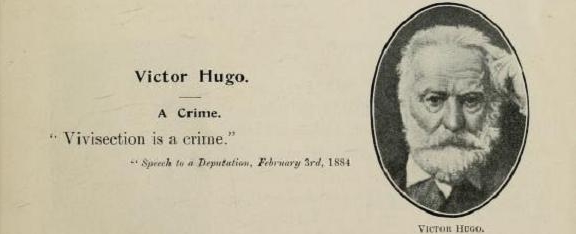
Victor Hugo did not say: “Nothing is more powerful than an idea whose time has come.”
THE ORIGIN OF THE FAMOUS MISQUOTE:
“On resiste a l’invasion des armees; on ne resiste pas a l’invasion des idees.” – from the final chapter of Hugo’s book Histoire d’un Crime (“The History of a Crime”), his account of the French coup d’état of 1851 that brought Napoleon III to power.
In reality, the literal English translation of the sentence from Hugo’s Histoire d’un Crime is:
“One can resist the invasion of armies; one cannot resist the invasion of ideas.”
The oft-cited English paraphrased versions were never spoken or written by Hugo.
Victor Hugo was the Founder of the – Union Internationale et Ligue Populaire Contre la Vivisection.
……………………………………………………………………….
Some powerful anti-vivisection quotes!
VIEWS of
Men and Women of Note…
ON THE
VIVISECTION
QUESTION
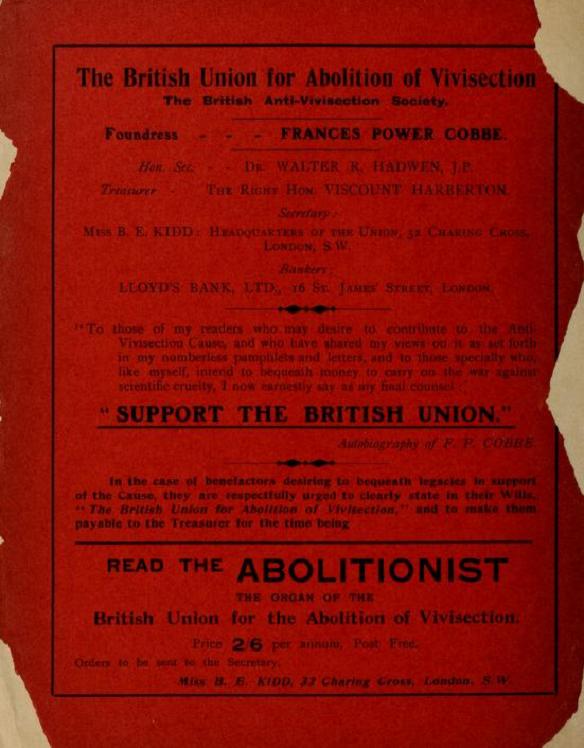
Here are some powerful anti-vivisection quotes from a 1906 publication – compiled by Dr. Walter R. Hadwen & friends.
It also quotes some sections of Ernest Bell’s Animals’ Friend journals – more sections of which we are in the process of transcribing.
We wanted to make the quotations fully searchable & add the Wikipedia pages for each of the persons quoted. Some were veg(etari)ans / plant-eaters – others were not. Many of their names appear in multiple sections of our Ernest Bell Library – supporting campaigns of The Humanitarian League – supporting the ‘Ragged School’ movement – working to abolish child-labour – working for prison reform – promoting London’s vegan soup kitchens – founding & running their own anti-vivisection organisations – supporting ‘Band of Mercy’ groups – supporting ‘Band of Hope groups etc., etc.
We were happy to find that every single person had their own Wikipedia page!
The Ernest Bell Library does not have a copy of this booklet – we have taken the content from here. We have not copied the inner covers – the scans were not clear.
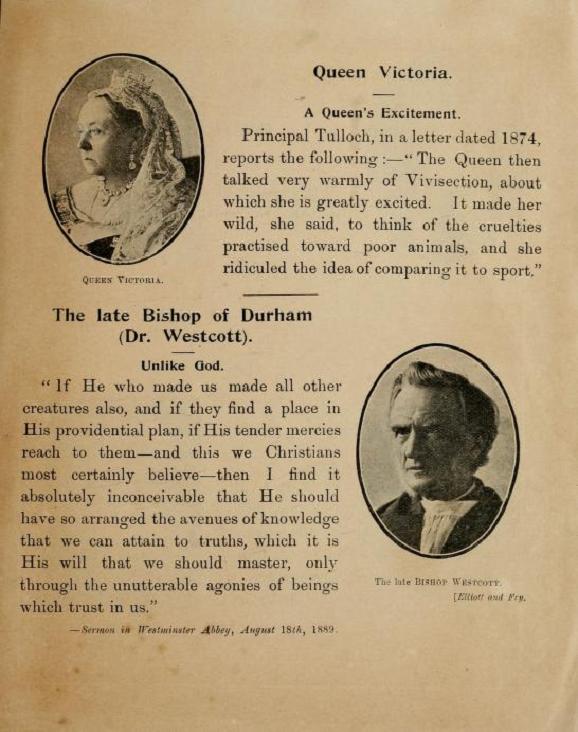
Queen Victoria.
A Queen’s Excitement.
Principal Tulloch, in a letter dated 1874, reports the following :- “The Queen then talked very warmly of Vivisection, about which she is greatly excited. It made her wild, she said, to think of the cruelties practised toward poor animals, and she ridiculed the idea of comparing it to sport.”
.
The late Bishop of Durham (Dr. Westcott).
Unlike God.
“If He who made us made all other creatures also, and if they find a place in His providential plan, if His tender mercies reach to them – and this we Christians most certainly believe – then I find it absolutely inconceivable that He should have so arranged the avenues of knowledge that we can attain to truths, which it is His will that we should master, only through the unutterable agonies of beings which trust in us.”
— Sermon in Westminster Abbey, August I8th, 1889.
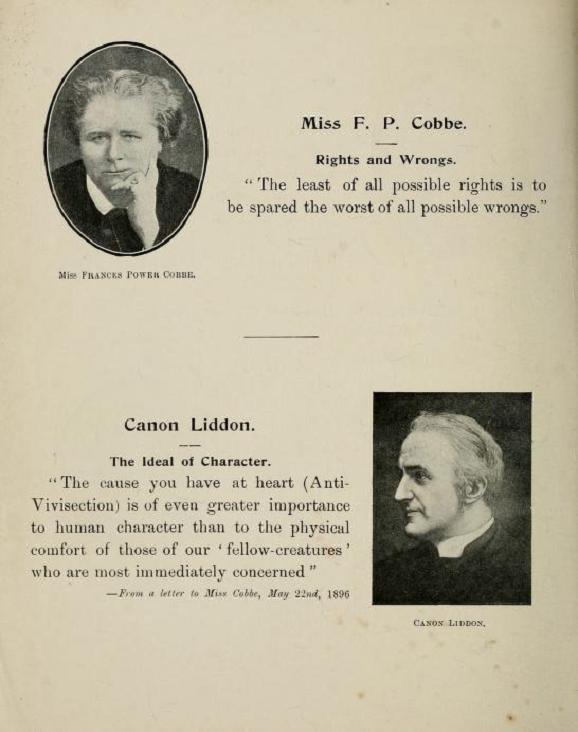
Miss F. P. Cobbe.
Rights and Wrongs.
“The least of all possible rights is to be spared the worst of all possible wrongs.”
Canon Liddon.
The Ideal of Character.
”The cause you have at heart (Anti- Vivisection) is of even greater importance to human character than to the physical comfort of those of our ‘fellow-creatures ‘ who are most immediately concerned.”
— From a letter to Miss Cobbe, May 22nd, 1896
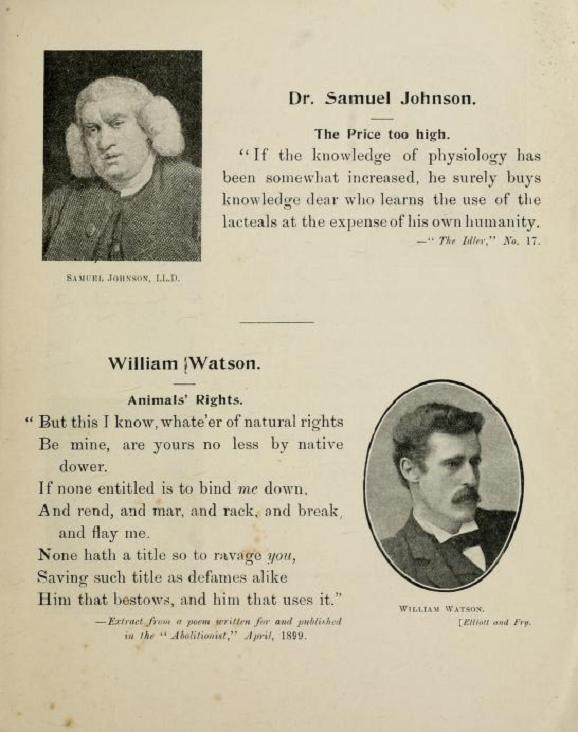
Dr. Samuel Johnson.
The Price too high.
“If the knowledge of physiology has been somewhat increased, he surely buys knowledge dear who learns the use of the lacteals at the expense of his own humanity.
— “The Idler” No. 17.
William Watson.
Animals’ Rights.
” But this I know, whate’er of natural rights
Be mine, are yours no less by native dower.
If none entitled is to bind me down.
And rend, and mar, and rack, and break,
and flay me.
None hath a title so to ravage you,
Saving such title as defames alike
Him that bestows, and him that uses it.”
— Extract from a poem written for and published in the ” Abolitionist,” April, 1899.
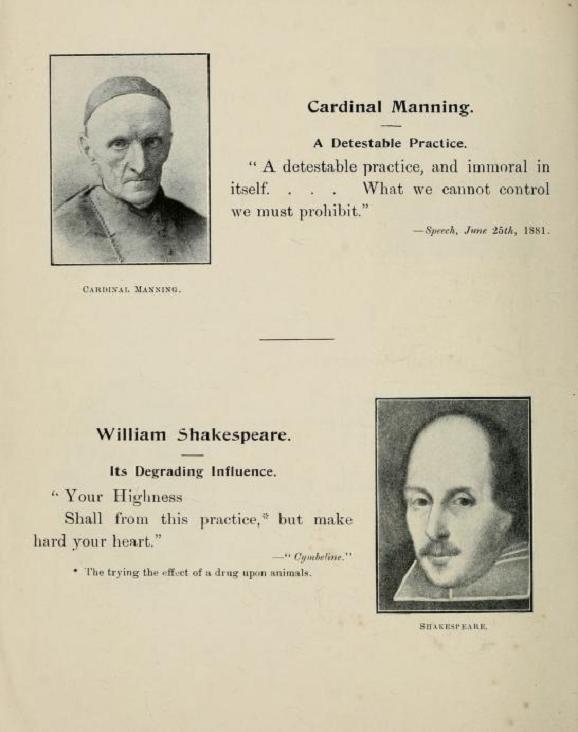
Cardinal Manning.
A Detestable Practice.
“A detestable practice, and immoral in itself. . . . What we cannot control we must prohibit.”
— Speech, June 25th, 1881.
William Shakespeare.
Its Degrading Influence.
“Your Highness
Shall from this practice,* but make
hard your heart.”
— “Cymbeline” * The trying the effect of a drug upon animals.
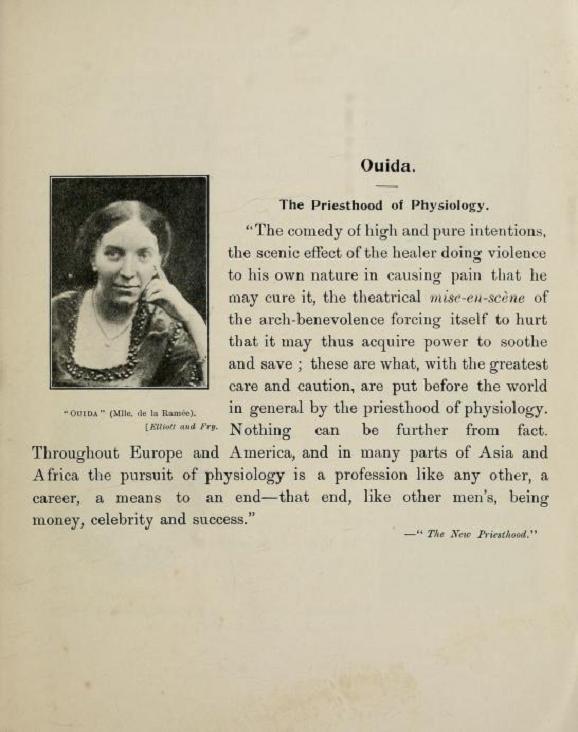
Ouida.
The Priesthood of Physiology.
“The comedy of high and pure intentions, the scenic effect of the healer doing-violence to his own nature in causing pain that he may cure it, the theatrical mise-en-scene of the arch-benevolence forcing itself to hurt that it may thus acquire power to soothe and save ; these are what, with the greatest care and caution, are put before the world in general by the priesthood of physiology. Nothing can be further from fact. Throughout Europe and America, and in many parts of Asia and Africa the pursuit of physiology is a profession like any other, a career, a means to an end — that end, like other men’s, being money, celebrity and success.”
— “The New Priesthood.”
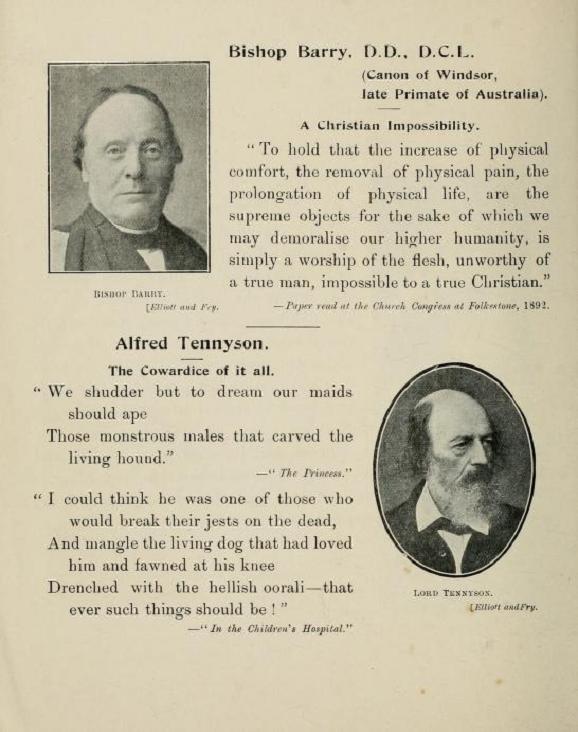
Bishop Barry, D.D., D.C.L.
(Canon of Windsor, late Primate of Australia).
A Christian Impossibility.
“To hold that the increase of physical comfort, the removal of physical pain, the prolongation of physical life, are the supreme objects for the sake of which we may demoralise our higher humanity, is simply a worship of the flesh, unworthy of a true man, impossible to a true Christian.”
— Paper read at, the Church Congress at Folkestone, 1892.
Alfred Tennyson.
The Cowardice of it all.
”We shudder but to dream our maids
should ape
Those monstrous males that carved the
living hound.”
— “The Princess.”
“I could think he was one of those who
would break their jests on the dead,
And mangle the living dog that had loved
him and fawned at his knee
Drenched with the hellish oorali — that
ever such things should be ! “
— “In the Children’s Hospital.'”
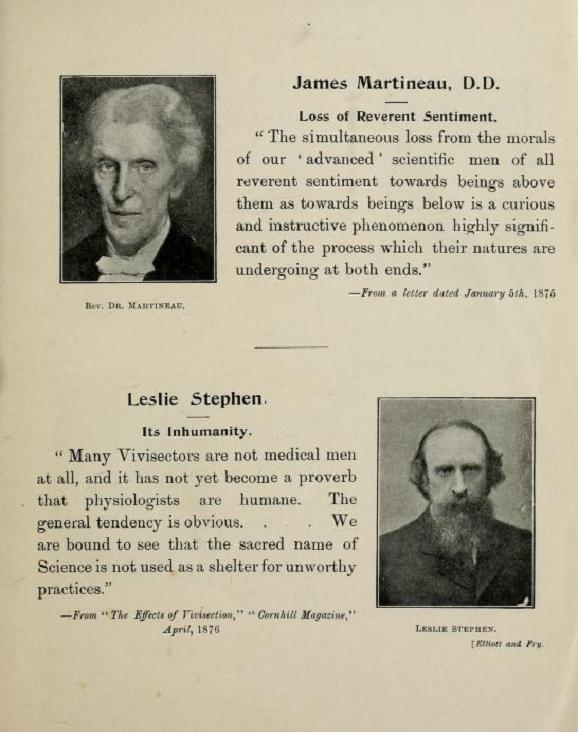
James Martineau, D.D.
Loss of Reverent Sentiment.
“The simultaneous loss from the morals of our ‘advanced’ scientific men of all reverent sentiment towards beings above them as towards beings below is a curious and instructive phenomenon highly signifi- cant of the process which their natures are undergoing at both ends.”
— From a letter dated January 5th, 1875
Leslie Stephen.
Its Inhumanity.
“Many Vivisectors are not medical men at all, and it has not yet become a proverb that physiologists are humane. The general tendency is obvious. . . We are bound to see that the sacred name of Science is not used as a shelter for unworthy practices.” — From “The Effects of Vivisection,”
— “Cornhill Magazine”, April, 1876
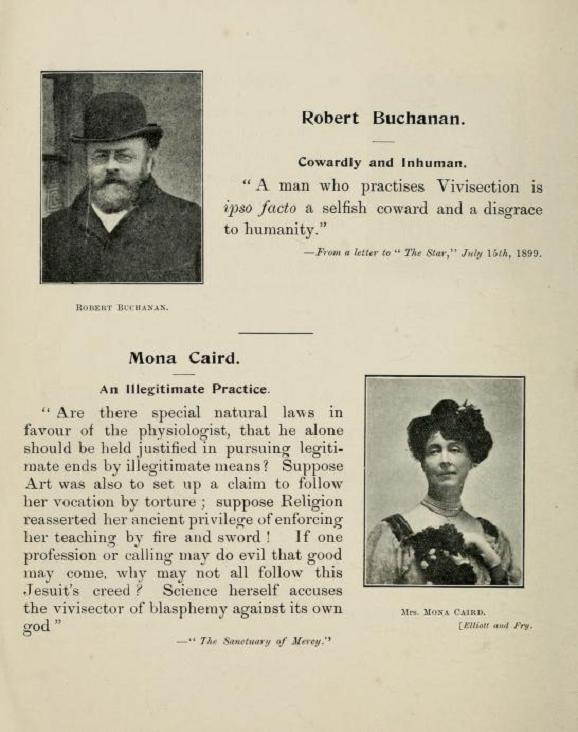
Robert Buchanan.
Cowardly and Inhuman.
“A man who practises Vivisection is ipso facto a selfish coward and a disgrace to humanity.”
— From a letter to “The Star,” July 10 th, 1899.
Mona Caird.
An Illegitimate Practice.
“Are there special natural laws in
favour of the physiologist, that he alone
should be held justified in pursuing legiti-
mate ends by illegitimate means? Suppose
Art was also to set up a claim to follow
her vocation by torture; suppose Religion
reasserted her ancient privilege of enforcing
her teaching by fire and sword! If one
profession or calling may do evil that good
may come, why may not all follow this
Jesuit’s creed? Science herself accuses
the vivisector of blasphemy against its own
god “
— “The Sanctuary of Mercy.”
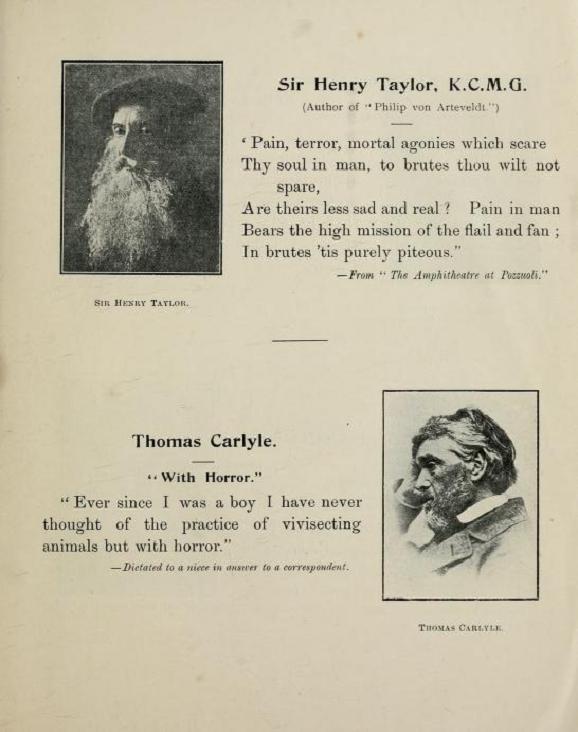
Sir Henry Taylor, K.C.M.G.
(Author of ” Philip von Arteveldt”)
‘Pain, terror, mortal agonies which scare
Thy soul in man, to brutes thou wilt not
spare,
Are theirs less sad and real ? Pain in man
Bears the high mission of the flail and fan;
In brutes ’tis purely piteous.”
— From “The Amphitheatre at Tozzuoli.”
Thomas Carlyle.
“With Horror.”
“Ever since I was a boy I have never thought of the practice of vivisecting animals but with horror”
— Dictated to a niece in answer to a correspondent.
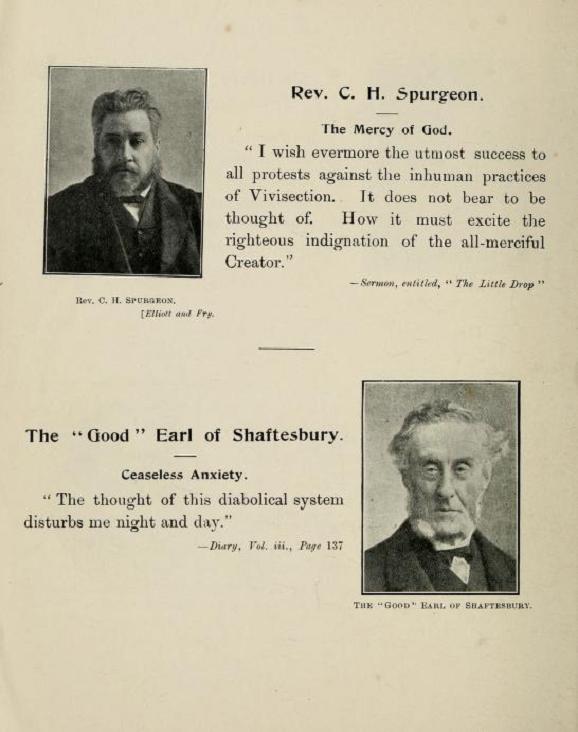
Rev. C. H. Spurgeon.
The Mercy of God.
“I wish evermore the utmost success to all protests against the inhuman practices of Vivisection. It does not bear to be thought of. How it must excite the righteous indignation of the all-merciful Creator.”
— Sermon, entitled, “The Little Drop”.
The ” Good ” Earl of Shaftesbury.
Ceaseless Anxiety.
“The thought of this diabolical system disturbs me night and day.”
— Diary, Vol. iii., Page 137
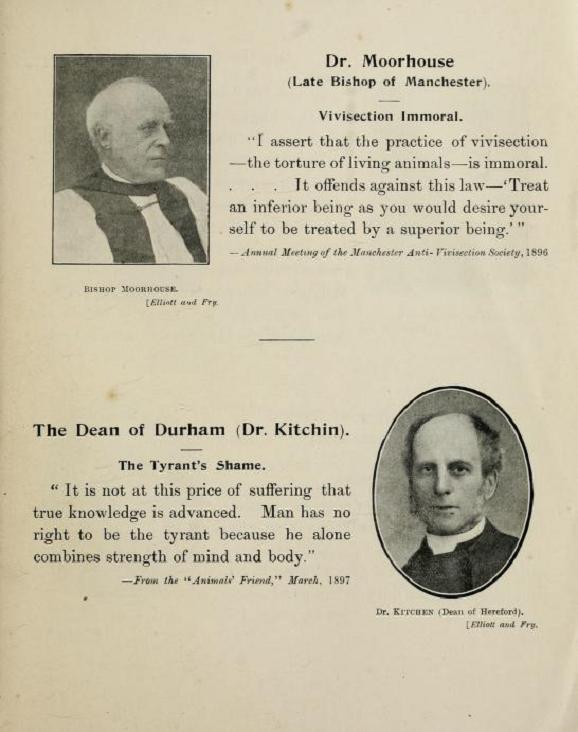
Dr. Moorhouse
(Late Bishop of Manchester).
Vivisection Immoral.
“I assert that the practice of vivisection – the torture of living- animals – is immoral. It offends against this law – ‘Treat an inferior being as you would desire your- self to be treated by a superior being.’ “
— Annual Meeting of the Manchester Anti- Vivisection Society, 1896
The Dean of Durham (Dr. Kitchin).
The Tyrant’s Shame.
“It is not at this price of suffering that true knowledge is advanced. Man has no right to be the tyrant because he alone combines strength of mind and body.”
— From the “Animals’ Friend,” March, 1897
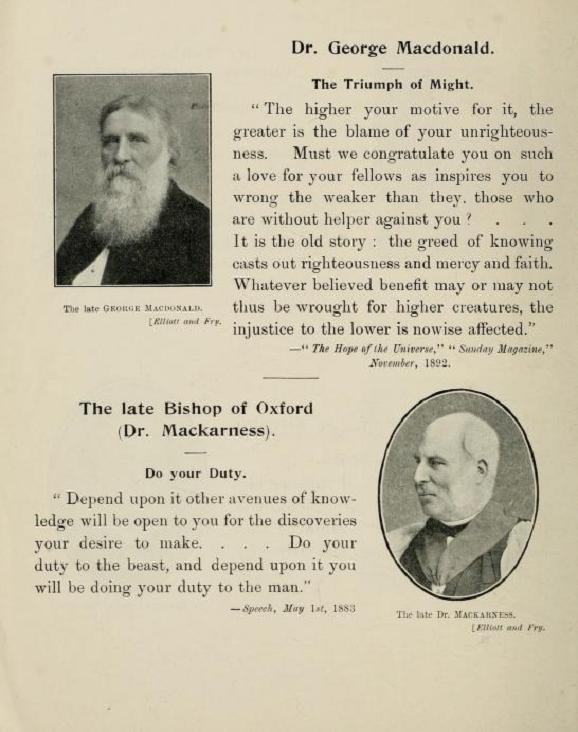
Dr. George Macdonald.
The Triumph of Might.
“The higher your motive for it, the greater is the blame of your unrighteous- ness. Must we congratulate you on such a love for your fellows as inspires you to wrong the weaker than they, those who are without helper against you ? It is the old story: the greed of knowing casts out righteousness and mercy and faith. Whatever believed benefit may or may not thus be wrought for higher creatures, the injustice to the lower is nowise affected.”
— “The Hope of the Universe,” – “Sunday Magazine,” November, 1892.
The late Bishop of Oxford
(Dr. Mackarness).
Do your Duty.
“Depend upon it other avenues of knowledge will be open to you for the discoveries your desire to make. . . . Do your duty to the beast, and depend upon it you will be doing your duty to the man.”
— Speech, May 1st, 1883
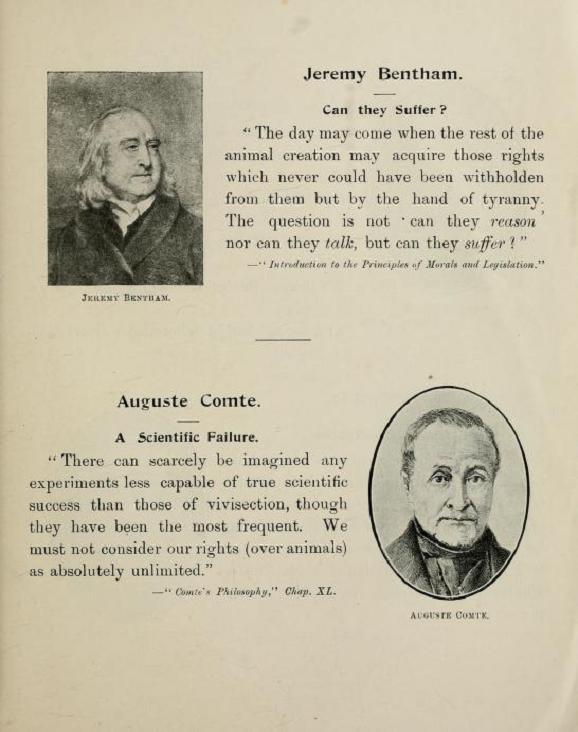
Jeremy Bentham.
Can they Suffer ?
“The day may come when the rest of the animal creation may acquire those rights which never could have been withholden from them but by the hand of tyranny. The question is not ‘can they reason‘ nor can they talk, but can they suffer?”
— “Introduction to the Principles of Morals and Legislation.”
Auguste Comte.
A Scientific Failure.
“There can scarcely be imagined any experiments less capable of true scientific success than those of vivisection, though they have been the most frequent. We must not consider our rights (over animals) as absolutely unlimited.”
— “Comte’s Philosophy,” Chap. XL.
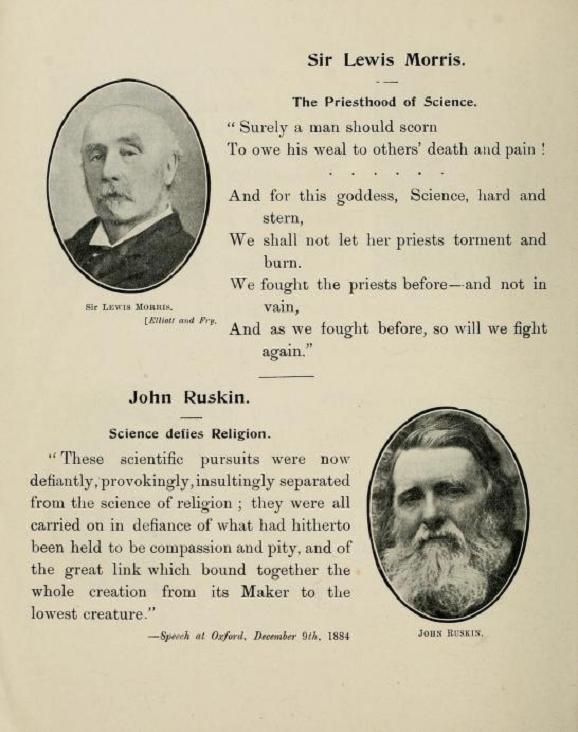
Sir Lewis Morris.
The Priesthood of Science.
“Surely a man should scorn
To owe his weal to others’ death and pain !
And for this goddess, Science, hard and
stern,
We shall not let her priests torment and
burn. We fought the priests before – and not in vain,
And as we fought before, so will we fight again.”
John Ruskin.
Science defies Religion.
“These scientific pursuits were now defiantly, provokingly, insultingly separated from the science of religion; they were all carried on in defiance of what had hitherto been held to be compassion and pity, and of the great link which bound together the whole creation from its Maker to the lowest creature.”
— Speech at Oxford, December 9th, 1884
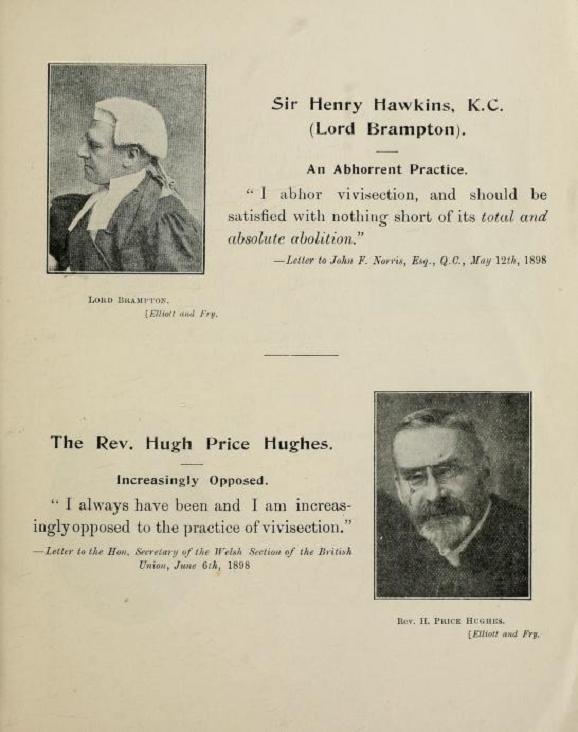
Sir Henry Hawkins, K.C. (Lord Brampton).
An Abhorrent Practice.
“I abhor vivisection, and should be satisfied with nothing short of its total and absolute abolition.”
— Letter to John F. Norris, Esq., Q.C., May 12th, 1898
The Rev. Hugh Price Hughes.
Increasingly Opposed.
“I always have been and I am increas- ingly opposed to the practice of vivisection.”
— Letter to the Eon. Secretary of the Welsh Section of the British Union, June 6th, 1898
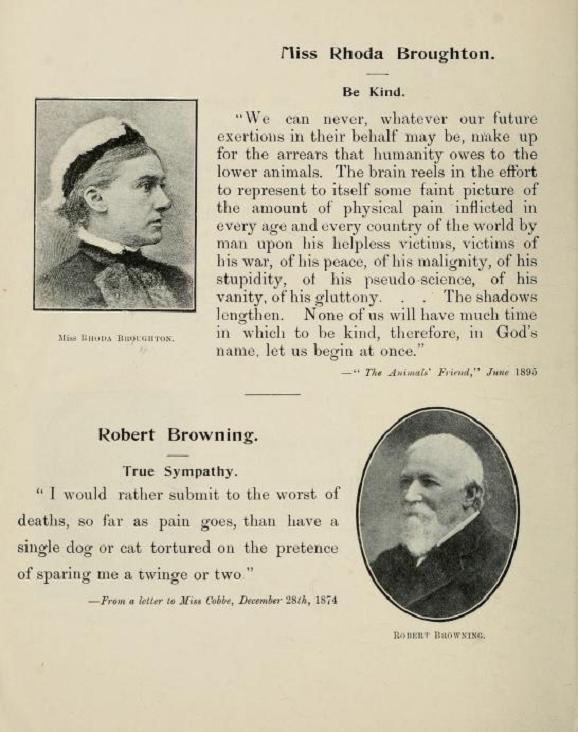
Miss Rhoda Broughton.
Be Kind.
“We can never, whatever our future exertions in their behalf may be, make up for the arrears that humanity owes to the lower animals. The brain reels in the effort to represent to itself some faint picture of the amount of physical pain inflicted in every age and every country of the world by man upon his helpless victims, victims of his war, of his peace, of his malignity, of his stupidity, of his pseudo-science, of his vanity, of his gluttony. . . The shadows lengthen. None of us will have much time in which to be kind, therefore, in God’s name, let us begin at once.”
— “The Animals’ Friend,” June 1895
Robert Browning.
True Sympathy.
“I would rather submit to the worst of deaths, so far as pain goes, than have a single dog or cat tortured on the pretence of sparing me a twinge or two.”
— From a letter to Miss Cobbe, December 28th, 1874
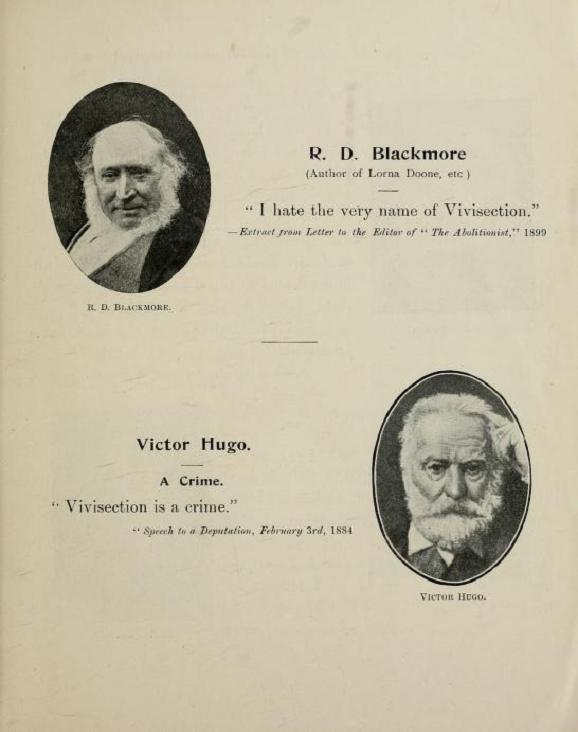
R. D. Blackmore
(Author of Lorna Doone, etc )
“I hate the very name of Vivisection.”
— Extract from Letter to the Editor of “The Abolitionist,” 1899
Victor Hugo.
A Crime.
“Vivisection is a crime.”
Speech to a Deputation, February 3rd, 1884
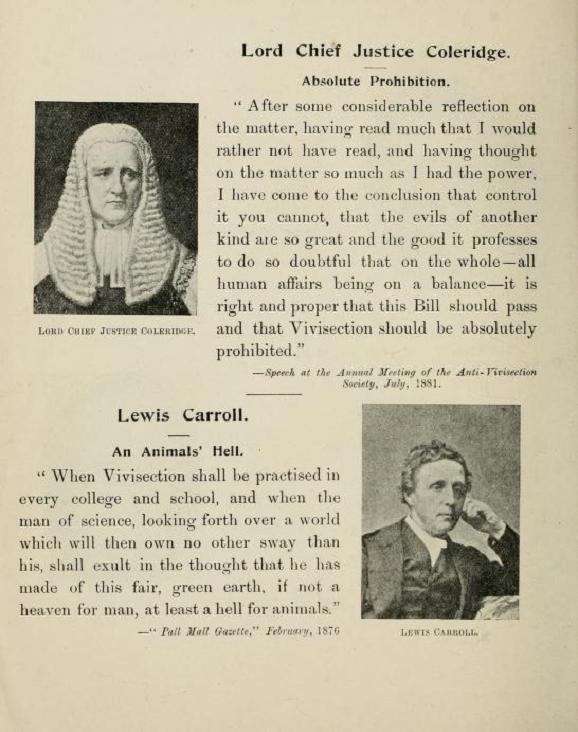
Lord Chief Justice Coleridge.
Absolute Prohibition.
“After some considerable reflection on the matter, having read much that I would rather not have read, and having thought on the matter so much as I had the power, I have come to the conclusion that control it you cannot, that the evils of another kind are so great and the good it professes to do so doubtful that on the whole – all human affairs being on a balance – it is right and proper that this Bill should pass and that Vivisection should be absolutely prohibited.”
— Speech at the Annual Meeting of the Anti- Vivisection Society, July, 1881.
Lewis Carroll.
An Animals’ Hell.
“When Vivisection shall be practised in every college and school, and when the man of science, looking forth over a world which will then own no other sway than his, shall exult in the thought that he has made of this fair, green earth, if not a heaven for man, at least a hell for animals.”
— “Pall Mall Gazette,” February, 1876
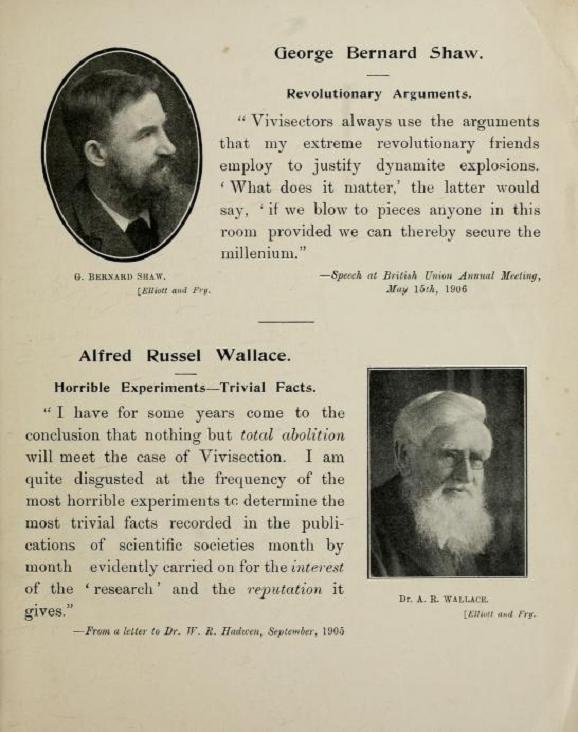
George Bernard Shaw.
Revolutionary Arguments.
“Vivisectors always use the arguments that my extreme revolutionary friends employ to justify dynamite explosions. ‘ What does it matter,’ the latter would say, ‘ if we blow to pieces anyone in this room provided we can thereby secure the millenium.'”
— Speech at British Union Annual Meeting, May 15th, 1906
Alfred Russel Wallace.
Horrible Experiments – Trivial Facts.
“I have for some years come to the conclusion that nothing but total abolition will meet the case of Vivisection. I am quite disgusted at the frequency of the most horrible experiments to determine the most trivial facts recorded in the publications of scientific societies month by month evidently carried on for the interest of the ‘research’ and the reputation it gives.”
— From a letter to Dr. W. R. Hadwen, September, 1905
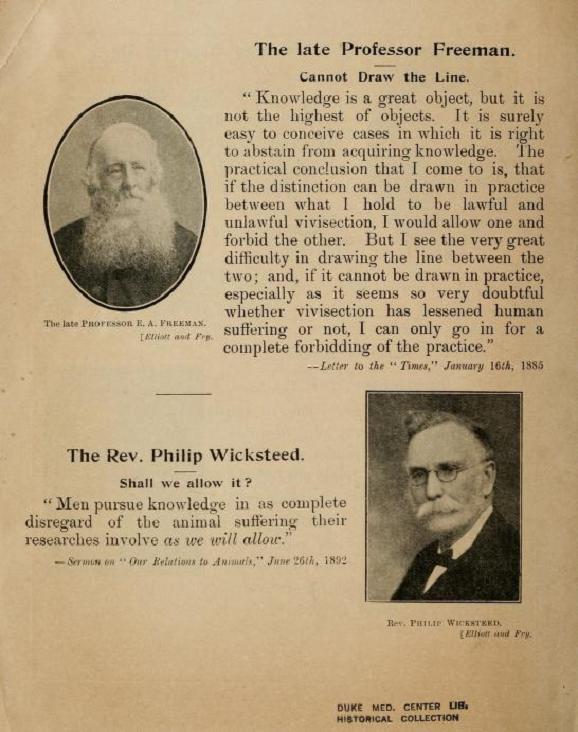
The late Professor Freeman.
Cannot Draw the Line.
“Knowledge is a great object, but it is not the highest of objects. It is surely easy to conceive cases in which it is right to abstain from acquiring knowledge. The practical conclusion that I come to is, that if the distinction can be drawn in practice between what I hold to be lawful and unlawful vivisection, I would allow one and forbid the other. But I see the very great difficulty in drawing the line between the two; and, if it cannot be drawn in practice, especially as it seems so very doubtful whether vivisection has lessened human suffering or not, I can only go in for a complete forbidding of the practice.”
— Letter to the ” Times,” January 16th, 1885
The Rev. Philip Wicksteed.
Shall we allow it?
“Men pursue knowledge in as complete disregard of the animal suffering their researches involve as we will allow.”
— Sermon on ” Our Relations to Animals.” June 26th, 1892
…………………………………………………………………………………………………………….
The Ernest Bell Library is actively preserving & sharing: –
-
items related to veg(etari)an products.
-
veg(etari)an books & other publications.
-
items related to veg(etari)an organisations.
-
items related to veg(etari)an businesses.
-
items related to animal rights organisations.
-
animal rights publications.
-
items related to humanitarian organisations.
-
humanitarian publications.
-
items related to rambling clubs run by members of the above groups & related publications.
No Comments